
With about 26% of the adult population sitting for more than eight hours a day the risks of physical inactivity taking a toll on your body are real.
If you’re looking for extra motivation to get up and get moving, there’s a powerful study documenting how physical inactivity for 8 hours a day can take years off your life.
The increased risk of early death adds to what we know about the harm of inactivity — which also includes increased risk of diabetes, cancer, heart disease, and obesity.
What’s your risk?
Researchers analyzed data from 16 different studies world-wide involving more than 1,000,000 people, most of whom were over 45. Study subjects were classified into activity levels of less than 5 minutes a day for the least active to 60 to 75 minutes for the most active.
The greatest risk was for people who both sat for long periods of time and were physically inactive. One interesting point was that people who sat for 4 hours and got no exercise each day were worse off than people who sat for 8 hours but got an hour or more of exercise daily.
And watching TV makes it worse. Sitting watching TV for more than 3 hours per day was associated with increased risk of death in all activity groups except the most active. And at more than 5 hours per day of TV, it didn’t matter how much you exercised, risk of death was increased.
What can you do to reduce your risk?
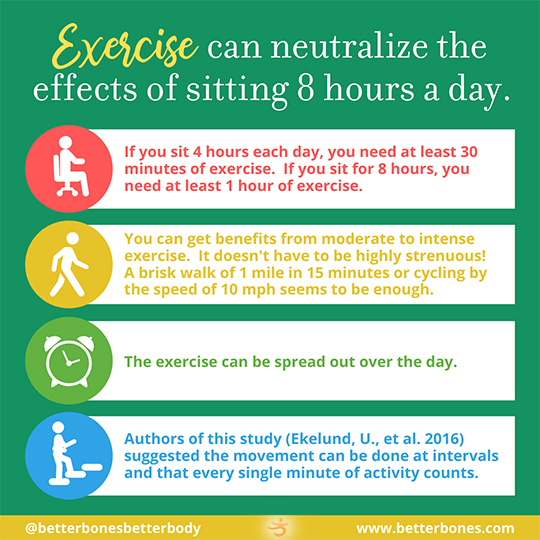
Here are more ideas to get moving
- Determine your daily sitting time and set your daily exercise requirement.
- Establish a routine for getting in those necessary minutes of physical activity: take a 15-minute walk before work, or park your car 10 minutes’ walk from your office. Then take a 20-minute brisk walk at lunchtime and another after work — and just like that, you’ll have negated most of the day’s sitting.
- Consider using an activity monitor like a Fitbit that can be set to track your minutes of active exercise. I set mine for 60 minutes a day to ensure I get up and out daily.
If you want to learn more about the risks of sitting, check out my blog, Is sitting the new smoking?
So let’s make 2020 our year to get out and moving — I’d love to hear about your exercise plan for 2020!
[av_toggle_container initial=’0′ mode=’accordion’ sort=” styling=” colors=” font_color=” background_color=” border_color=” av_uid=’av-r2ouygn4′ custom_class=”]
[av_toggle title=’References’ tags=” av_uid=’av-i67txfpc’]
References:
Ding, Ding, et. al. 2016. The economic burden of physical inactivity: A global analysis of major non-communicable diseases. The Lancet, 388(10051):1311–1324. http://dx.doi.org/10.1016/S0140-6736(16)30383-X
Ekelund, U., et al. 2016. Does physical activity attenuate, or even eliminate, the detrimental association of sitting time with mortality? A harmonised meta-analysis of data from more than 1 million men and women. The Lancet, 388(10051):1302–1310. http://dx.doi.org/10.1016/S0140-6736(16)30370-1
[/av_toggle]
[/av_toggle_container]