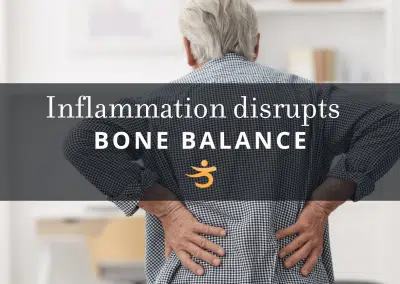

These days, it seems like the media is full of folks talking about aging bone loss in women. What they seem to often forget, however, is that just as we lose bone mass over time, so we also lose muscle mass — and most often, the two are linked.
Let’s look at the spine as an example. The average woman loses about 47% of her spinal bone mass during her lifetime, while most men lose 30% of their spinal bone density as they age. As for muscle loss, studies estimate that between the ages of 21 and 89, a woman loses 50% of her back muscle strength and a man loses 64%. This is the normal, average loss of bone and muscle in long-lived Americans. Excessive bone loss and the condition of weak bones is called “osteoporosis” and excessive muscle loss and weakened muscles is called “sarcopenia.” The longer you live, the more likely excessive bone and/or muscle loss will become a factor that limits your vitality.
Longer life means a greater chance of losing excessive amounts of your youthful bone and muscle mass, unless you take deliberate steps to head in another direction. An action plan for building the health, strength, and fitness of the entire body is the antidote to age-related losses. If you care for your bones in a natural, holistic fashion, as with my Better Bones Health Package you are actively involved in an anti-aging program.
In our program, everything you do for bone is good for the entire body. Every nutrient you take, every step you make towards developing an Alkaline For Life® eating plan, every physical exercise you do is a move towards preserving bone, muscle, and vitality.
References:
Riggs, B.L., Melton, L.J. III. 1986. Involutional osteoporosis. N. Engl. J. Med., 314:1676–1686.
Riggs, B.L., Wahner, H.W., Melton, L.J. III, et al. 1986. Rates of bone loss in the appendicular and axial skeletons of women: Evidence of substantial vertebral bone loss before menopause. J. Clin. Invest., 77:1487-1491.
Scheffler, N.M., Sheitel, P.L., and Lipton, M.N. 1992. Use of cryo/cuff for the control of postoperative pain and edema. J. Foot Surg., 31:141-148.
Sinaki, M. 2003. Critical appraisal of physical rehabilitation measures after osteoporotic vertebral fracture. Osteo. Int., 14:773-779.