[ Video Short Placeholder ]
Dr. Susan Brown: The Best Copper for Osteoporosis in 60 Seconds
If you’re researching the best copper for osteoporosis, you’re paying attention to one of the most quietly important minerals in bone health. Copper isn’t flashy like calcium or trendy like collagen — but without it, your body literally cannot finish the collagen scaffolding that holds your skeleton together. The difference between a flexible, fracture-resistant bone and a brittle one often comes down to whether copper is doing its job.
In this guide, Dr. Susan Brown — author of Better Bones, Better Body and developer of the Better Bones Solution — explains exactly what copper does for your bones, which form to take, how much, and why the zinc-to-copper ratio in your supplement matters more than most people realize.
Copper Is a Collagen Matrix Builder — The “Cross-Link Forger” of Your Skeleton
In Dr. Brown’s 20 Key Bone-Building Nutrients framework, nutrients work together across four cooperating systems. Copper sits squarely in the Collagen Matrix Builders — the crew that constructs and stabilizes the flexible protein scaffolding that gives bone its tensile strength.
Think of your bone as a house. Calcium and phosphorus are the bricks. Protein and collagen are the lumber. Vitamin C is the framing carpenter, zinc is the finish carpenter, and manganese is the glue maker. Copper is the cross-link forger. Through the copper-dependent enzyme lysyl oxidase, copper creates the mature, irreversible bonds that hold collagen fibrils together side-by-side — the cross-links that turn loose protein strands into strong, stable, fracture-resistant rope. Without enough copper, those cross-links never form, and the matrix stays weak no matter how much collagen you eat.
Dr. Brown’s therapeutic target for copper is roughly 1.5–3 mg per day for women supporting bone health — and crucially, in a 10:1 to 15:1 zinc-to-copper ratio so the two minerals stay in balance.
What Copper Actually Does for Bone
Like manganese, copper is an essential trace mineral that has only recently been found to play an important role in bone health maintenance. This role is still not fully understood, but we do know that by virtue of a copper-containing enzyme called lysyl oxidase, copper aids in the formation of collagen for bone and connective tissue and contributes to the mechanical strength of bone collagen fibrils — the long thin strands of proteins that cross-link to one another in the spaces around cells.
Copper also helps inhibit bone resorption through a copper- and zinc-containing antioxidant called superoxide dismutase. This antioxidant neutralizes superoxide radicals produced by the bone-breakdown cells called osteoclasts during bone resorption.
Again, as with manganese, inadequate copper levels have been associated with the development of osteoporosis. And as with so many other minerals, copper excretion from the body is increased on a diet high in sugar, other sweeteners like fructose, and refined flour. Some researchers have suggested that even lactose (milk sugar) could interfere with copper metabolism, making high dairy intake less than ideal for copper utilization. With our penchant for sugar, refined flour, and dairy, it’s not surprising that copper is among the minerals most often deficient in the American diet.
The Critical Zinc-Copper Balance
This is the single most important thing to understand about copper supplementation: zinc and copper compete for absorption in the gut. Take too much zinc on its own — even at moderate doses of 25–40 mg per day for months — and you can drive copper down into deficiency, undoing the bone benefit you were hoping for.
Dr. Brown recommends keeping zinc and copper supplementation in roughly a 10:1 to 15:1 ratio. So if you’re taking 15 mg of zinc per day for bone support, you want about 1–1.5 mg of copper alongside it. Most quality bone formulas already get this ratio right; if you’re stacking single-ingredient supplements, it’s worth checking your math.
Best Copper for Osteoporosis: Which Form Should You Take?
Copper supplements come in several forms. Here is how Dr. Brown ranks them.
1. Copper Sebcate
While copper is an mineral essential for bone health, it is only needed in very small quantities and in balance with zinc. The form we currently prefer is copper sebcate, a form used in European nutritional and biological medicine traditions. It provides good bioavailability, is gentle on the gastrointestinal tract, provide stable mineral delivery and has less of a tendency to participate in unwanted oxidative reactions than some of the inorganic copper salts.
2. Copper Bisglycinate (Glycinate Chelate)
Copper bound to two glycine molecules — excellent absorption, very gentle on the stomach, and Dr. Brown’s preferred form for daily bone-support dosing.
3. Copper Citrate
Bound to citric acid — well absorbed, easy on the gut, widely available. A solid mid-range option.
4. Copper Gluconate
Common in over-the-counter multivitamins. Adequately absorbed and a reasonable budget choice.
5. Copper Oxide — Avoid
Cheap and used in some bargain multis, but very poorly absorbed. If your label only says “copper oxide,” you’re not getting much.
How Much Copper Do You Need for Healthy Bones?
The federal RDA for copper is 900 mcg/day (0.9 mg) for adults — Dr. Brown considers this a floor, not a target.
- Baseline wellness: 1–2 mg/day from food and supplements combined
- Active bone-building / postmenopausal women: 1.5–3 mg/day total, ideally paired with 15–25 mg of zinc
- Upper safety limit: 10 mg/day from supplements (the federal Tolerable Upper Intake Level for adults). Stay well below this.
Timing: Take copper with food. Avoid taking it at the same time as a high-dose zinc supplement (separate by 2 hours), or — better yet — take a single bone formula that combines them at the proper ratio so you don’t have to think about it.
Important note about copper IUDs and high-copper water: If you have a copper IUD or live in an area with very high copper in your drinking water, talk to your practitioner before adding a copper supplement.
Get Copper in the Right Form — and the Right Ratio
Dr. Brown’s Complete Bone Supplement Guide walks you through the exact copper form, dose, and zinc-to-copper ratio she recommends for postmenopausal bone health.
Best Food Sources of Copper
Copper is one of the easiest minerals to get from a real, whole-food diet — and one of the easiest to miss on a refined diet heavy in sugar and white flour.
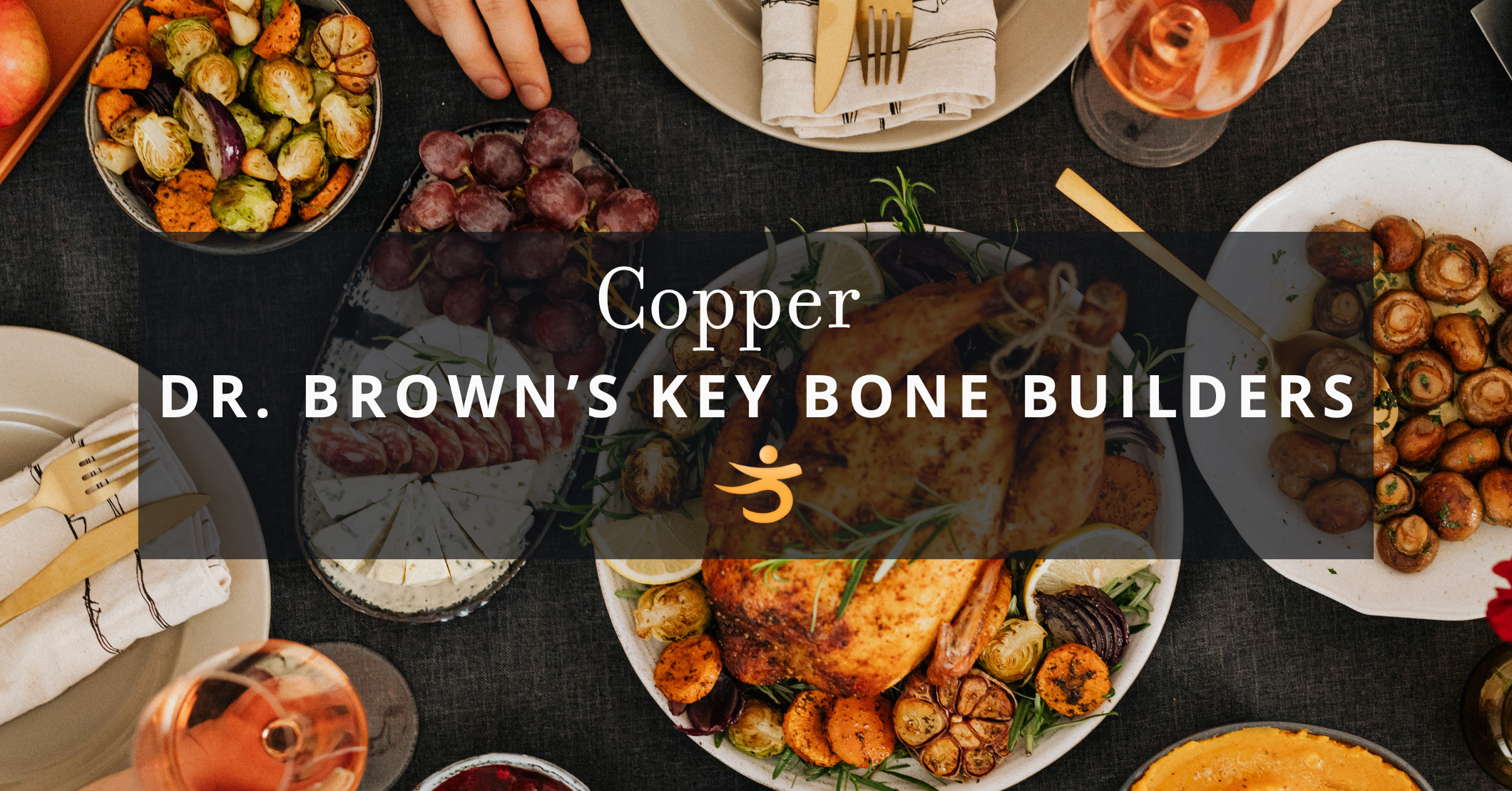
- Beef liver and other organ meats — by far the richest sources (about 14 mg per 3-oz serving of beef liver)
- Oysters — also exceptionally rich
- Dark chocolate (70%+) and unsweetened cocoa
- Cashews, hazelnuts, almonds, sunflower seeds, sesame seeds
- Mushrooms — especially shiitake
- Lentils, chickpeas, white beans
- Whole grains — buckwheat, oats, quinoa
- Leafy greens — spinach, Swiss chard, kale
- Avocado
Copper Works Best With Its Partner Nutrients
Copper is part of the Collagen Matrix Builders crew. Its closest partners are:
- Zinc — paired absorption and antioxidant function (superoxide dismutase). Always balance the two.
- Vitamin C — together with copper, drives lysyl oxidase activity and collagen cross-linking
- Manganese — works alongside copper for connective-tissue strength
- Silicon (silica) — bridges collagen and the mineralization interface
- Protein and collagen peptides — the raw building blocks copper helps stabilize
Putting It All Together
Copper is the unsung hero of the bone matrix. Get 1.5–3 mg per day in a chelated form, balance it with zinc at a 10:1 to 15:1 ratio, eat liver, oysters, dark chocolate, and nuts regularly, and you give your collagen the cross-links it needs to be strong, flexible, and fracture-resistant.
For a complete breakdown of the most effective options, see our guide to the best supplements for bone health.
Ready to Build Stronger Bones — for Life?
Dr. Brown’s Better Bones Solution teaches her complete 6-step protocol for lifelong strong bones — the same program she has used with thousands of women to stop bone loss and build new bone naturally.
Related Reading From Better Bones
- The 20 Key Bone-Building Nutrients: Complete Overview
- Best Zinc for Osteoporosis
- Best Manganese for Osteoporosis
- Best Vitamin C for Osteoporosis
- Best Collagen for Osteoporosis
- Best Protein for Osteoporosis
- Bone Physiology Basics: How Bone Builds and Breaks Down
- Essential Nutrients for Building Better Bones
- Science-Backed Supplements for Stronger Bones
Scientific References
- Strause L, Saltman P, Smith KT, Bracker M, Andon MB. Spinal bone loss in postmenopausal women supplemented with calcium and trace minerals. J Nutr. 1994;124(7):1060-1064. PubMed
- Eaton-Evans J, McIlrath EM, Jackson WE, McCartney H, Strain JJ. Copper supplementation and the maintenance of bone mineral density in middle-aged women. J Trace Elem Exp Med. 1996;9(3):87-94. PubMed
- Palacios C. The role of nutrients in bone health, from A to Z. Crit Rev Food Sci Nutr. 2006;46(8):621-628. PubMed
- Lowe NM, Lowe NM, Fraser WD, Jackson MJ. Is there a potential therapeutic value of copper and zinc for osteoporosis? Proc Nutr Soc. 2002;61(2):181-185. PubMed
- National Institutes of Health, Office of Dietary Supplements. Copper — Health Professional Fact Sheet. ods.od.nih.gov