[ Video Short Placeholder ]
Dr. Susan Brown: The Best Boron for Osteoporosis in 60 Seconds
If you’re looking for the best boron for osteoporosis, you’re about to meet one of the most overlooked bone-building nutrients in the 20 Key Nutrients system. Boron is a trace mineral — you only need milligrams a day — but those milligrams unlock vitamin D, conserve calcium and magnesium, and help balance the hormones that protect your skeleton.
In this guide, Dr. Susan Brown — author of Better Bones, Better Body and developer of the Better Bones Solution — explains exactly how boron supports bone health, the best forms to take for osteoporosis, how much you need, and which food sources and partner nutrients help it work.
Boron Is a Nutrient Director — The “Activator” of Your Bone-Building Crew
In Dr. Brown’s framework, nutrients work together across four cooperating systems. Boron belongs to the 20 Key Bone-Building Nutrients — specifically as one of the Nutrient Directors.
Think of your bone as a busy construction site. Calcium and phosphorus are the bricks and concrete. Protein and collagen are the lumber. Vitamin C is the carpenter. But even with all those materials, the job stalls if the key enzymes and hormones that drive bone formation aren’t switched on. Boron is the activator. It helps convert vitamin D into its active form, holds onto the calcium and magnesium your bones need, and keeps estrogen and testosterone at levels that protect bone.
Dr. Brown’s therapeutic target for boron is 3–5 mg per day — a tiny dose with outsized effects on bone metabolism.
Three Ways Boron Is Essential for Healthy Bones
Boron is involved in a great variety of complex and interrelated metabolic processes. Here are three ways it directly supports bone health:
- Boron activates vitamin D. Boron boosts the enzymes that convert inactive vitamin D into its active hormone form (calcitriol), the form that actually drives calcium absorption. Without enough boron, even good vitamin D levels underperform for bone.
- Boron conserves calcium and magnesium. Classic research by Dr. Forrest Nielsen at the USDA showed that adding a few milligrams of boron per day cut urinary calcium loss by up to 44% and urinary magnesium loss significantly — especially in postmenopausal women. Less mineral lost in the urine means more available for bone health.
- Boron supports bone-protective hormones. Boron helps the body maintain healthy levels of 17β-estradiol and testosterone — hormones that directly influence bone remodeling — and modulates the activity of sex-hormone-binding globulin, which keeps those hormones bioavailable to bone cells.
There is no official RDA for boron, but an intake of 3–5 mg per day from a combination of food and supplements matches Dr. Brown’s therapeutic range for active bone-building women.
Best Boron for Osteoporosis: Which Form Should You Take?
Not all boron supplements are created equal — and for bone health specifically, form determines how well your body can actually use the mineral.
1. Boron Citrate
Boron bonded to citric acid. Well absorbed, gentle on the stomach, and the form Dr. Brown most often recommends when a standalone boron supplement is called for. Citrate also contributes mildly to alkaline balance — a bonus for bone.
2. Boron Glycinate
Boron bonded to the amino acid glycine (a “chelate”). Highly bioavailable and well tolerated. A good choice for women with sensitive digestion.
3. Calcium Fructoborate (Whole-Food-Like Boron)
This is the complex form of boron found naturally in plants — calcium, fructose, and boron bonded together the way your body encounters them in fruits and vegetables. Research suggests fructoborate is especially well utilized and may offer additional joint and inflammation benefits alongside bone support.
4. Boron in a Bone-Focused Multi-Mineral
For most women, the easiest way to cover boron is as part of a broad-spectrum bone multi-mineral that also delivers calcium, magnesium, vitamin D, vitamin K2, zinc, manganese, copper, and silica at therapeutic levels. This ensures boron arrives alongside the partner nutrients it activates.
What to avoid
Avoid boric acid as a dietary supplement (it’s a pesticide and an irritant), and avoid mega-doses above 20 mg per day unless specifically directed by a practitioner. More is not better with boron — the therapeutic window is small and well-defined.
How Much Boron Do You Need for Strong Bones?
Dosing depends on your stage of life and goals:
- Baseline wellness: 1–3 mg/day, easily reached from a diet rich in fruits, nuts, and legumes
- Active bone-building / postmenopausal women: 3–5 mg/day, ideally from food plus a bone-focused multi-mineral
- Short-term therapeutic use: Up to 6–10 mg/day may be used under practitioner guidance for conditions like osteoarthritis or significant bone loss
How to take it: Boron is well absorbed with or without food. Take it consistently, every day — boron’s benefits (vitamin D activation, mineral conservation, hormone support) build over weeks, not minutes.
Get the Right Boron — and the Co-Factors It Works With
Dr. Brown’s Complete Bone Supplement Guide walks you through the exact boron forms, doses, and partner nutrients she recommends for rebuilding bone — with calcium, magnesium, vitamin D, and vitamin K2 properly balanced.
Best Food Sources of Boron
Food first, always — then add supplements to fill the gap between what you eat and your therapeutic target. Boron is concentrated in plants grown in boron-rich soils:
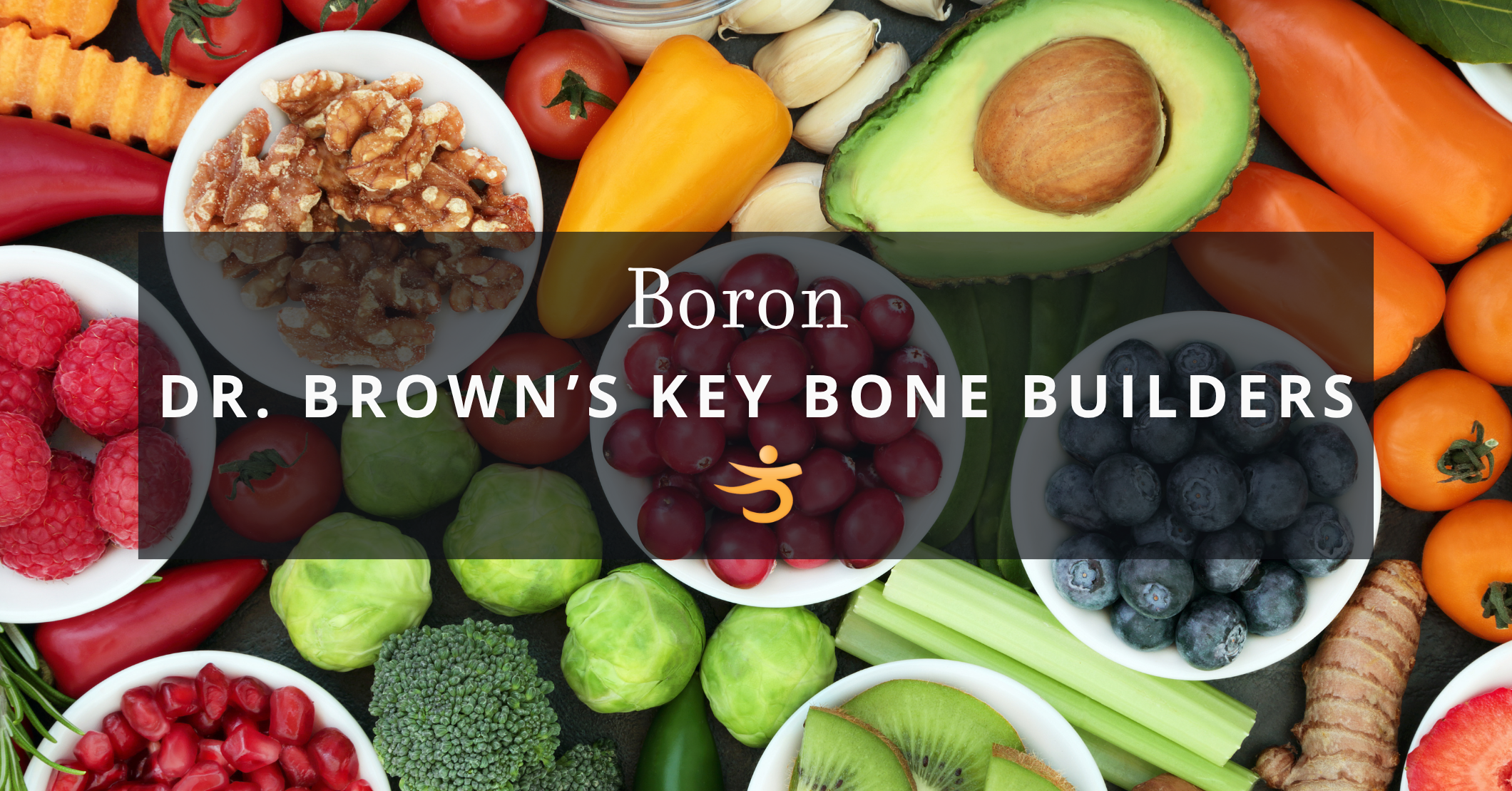
- Prunes and raisins — a small handful can deliver 1–2 mg; Dr. Brown often calls prunes a “bone superfood”
- Avocados — one of the most concentrated whole-food sources (about 1 mg per medium fruit)
- Almonds, hazelnuts, walnuts, and peanuts — about 1–2 mg per quarter cup
- Apples, pears, peaches, and grapes — everyday bone-friendly fruits
- Chickpeas, lentils, and kidney beans — reliable plant sources for vegetarians
- Leafy greens, broccoli, and parsley — alkalizing boron sources that also supply vitamin K and magnesium
Because boron content varies with soil quality, eating a variety of plant foods from different sources is the best way to secure a steady daily intake.
Boron Works Best With Its Partner Nutrients
Because boron is a Nutrient Director, it works hand-in-hand with the other members of that crew:
- Vitamin D — boron activates vitamin D; the two are inseparable for calcium absorption
- Calcium — boron reduces urinary calcium loss, multiplying the return on your calcium intake
- Magnesium — boron helps retain magnesium, and magnesium helps convert vitamin D alongside boron
- Vitamin K2 (MK-7) — directs the calcium boron helps you conserve into bone rather than soft tissue
- Protein and collagen peptides — the structural raw materials boron’s activated hormones help lay down
Taking boron alongside a broad-spectrum bone multi-mineral — rather than in isolation — is the key to unlocking its full activating power.
Putting It All Together
Boron is one of the smallest, most overlooked, and most powerful nutrients for bone health. Getting just 3–5 mg per day from a mix of prunes, nuts, avocados, and a bone-focused multi-mineral can significantly improve how well your body uses every other bone nutrient you take in.
Compare all the options in our comprehensive resource on which supplements actually help bone density.
Ready to Build Stronger Bones — for Life?
Dr. Brown’s Better Bones Solution teaches her complete 6-step protocol for lifelong strong bones — the same program she has used with women worldwide to rebuild bone naturally.
Related Reading From Better Bones
- The 20 Key Bone-Building Nutrients: Complete Overview
- Best Vitamin C for Osteoporosis: Dr. Brown’s Complete Guide
- Best Vitamin A for Osteoporosis: Dr. Brown’s Complete Guide
- Best Collagen for Osteoporosis: Dr. Brown’s Complete Guide
- Best Protein for Osteoporosis
- Best Calcium for Osteoporosis
- Best Magnesium for Osteoporosis
- Vitamin D for Bone Health
- Which Supplements Actually Help Bone Density?
- Better Bones Basics: Where to Start
Scientific References
- Nielsen FH, Hunt CD, Mullen LM, Hunt JR. FASEB J. 1987;1(5):394-397. Effect of dietary boron on mineral, estrogen, and testosterone metabolism in postmenopausal women. PubMed
- Pizzorno L. Integr Med (Encinitas). 2015;14(4):35-48. Nothing boring about boron. PubMed
- Scorei R, Rotaru P. Biol Trace Elem Res. 2011;143(3):1223-1238. Calcium fructoborate — potential anti-inflammatory agent. PubMed
- Nielsen FH. Magnes Trace Elem. 1990;9(2):61-69. Studies on the relationship between boron and magnesium which possibly affects the formation and maintenance of bones. PubMed
- National Institutes of Health, Office of Dietary Supplements. Boron — Dietary Supplement Fact Sheet. ods.od.nih.gov