home » blog »
Print Bookmark Size small medium large

Stronger back muscles can lower future fracture risk

From Sinaki M, Wahner HW, Offord KP, Hodgson SF. Efficacy of nonloading exercises in prevention of vertebral bone loss in postmenopausal women: a controlled trial. Mayo Clin Proc. 1989;64(6):762-769. Used with permission.


Exercise builds muscle and bone, but the benefits are held to disappear upon exercise cessation — or so it appeared, anyway. A recent exercise study from the Mayo Clinic, however, documented powerful spinal fracture reduction eight years after cessation of a back strengthening program. Eight years after stopping this two-year exercise program, past exercisers had significantly greater bone density, and nearly a 2.7 times lower vertebral compression fracture incidence, than non-exercising controls.

This study found that healthy postmenopausal women can reduce their 10-year risk of vertebral fracture by nearly 300% with one simple back exercise performed 5 days a week. As suggested by this study, back-strengthening exercise is far more effective at reducing spinal fracture than any drug therapy and is totally safe — a true Better Bones, Better Body® Approach. Let’s look at the study in detail.

This Mayo Clinic study involved 50 healthy Caucasian postmenopausal women ages 58–75, with no back pain or injury. The women were divided into 2 groups for a 2-year randomized controlled exercise trial. Twenty-seven women performed progressive, resistive back-strengthening exercises, and twenty-three served as non-exercising controls. Measurements were made of back extensor muscle strength, bone mineral density, and spinal deformity.

At baseline, back extensor muscle strength was similar in both groups (exercisers at 39.4 kg and controls at 36.9 kg) and there was no significant difference in bone mineral density. By the end of the 2-year study period, exercisers had increased back extensor strength by some 70% while controls gained 32% in strength and there was no significant difference in bone mineral density between the two groups. At 10 years, the exercising group had lost 16.5% of their baseline back strength (down to 32.9 kg from 39.4) and the control had lost 27.1% of their baseline strength (down to 26.9 from 36.6 kg). The difference in back strength was still significant at 10 years. Overall, exercisers lost 1.65% back muscle strength per year while controls lost 2.7% a year. Bone density declined in both groups, but at 10 years, exercisers had significantly greater bone density than controls. Most importantly, among past exercisers, spinal compression fractures rates were 2.7 lower even 8 years after cessation of the back-strengthening exercise program.

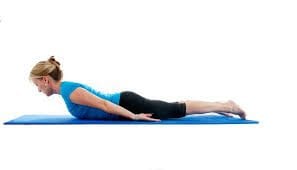
And what was this effective exercise program? Women were instructed in progressive, resistive weight-lifting exercise for the back extensor muscles. They used a backpack that contained weights equivalent to 30% of the maximal isometric back extensor strength. Lying in a prone position (on their stomachs) they lifted the backpack ten times (see illustration). As their back strength increased, the amount of weight lifted was increased. The maximum weight of the backpack was 50 lbs. Women did the 10 repetitions of this back weight-lifting exercise 5 days a week for 2 years.

Reference:
Sinaki, M, et al. 2002. Stronger back muscles reduce the incidence of vertebral fractures: A prospective 10-year follow-up of postmenopausal women. Bone, 30(6):836-841.


We created the Osteo Blast blog as our forum to express opinions and educate the public about natural means of supporting and improving bone health and overall wellness. As part of this forum, we sometimes discuss medical issues and medications, and their effects on bone health in general. However, we cannot advise readers about specific medical issues in this forum. If you wish to obtain advice from Susan E. Brown, PhD, about your specific bone health and nutritional concerns, please visit our Consultations page. Other specific medical questions should be referred to your healthcare provider.

Comments

August 24. 2009 20:11

Thanks for this blog.  I am learning so much from it!

Shelley Zafran

August 25. 2009 13:00

Great information! Thank you Dr. Brown for keeping us updated.

But it looks like none of the study participants already had osteopenia or osteoporosis.  Is there any information on the safety of this for us?
Warmly, Santa Fe

Santa Fe

August 25. 2009 16:36

Santa Fe,
Good concern, it is also good to check with your doctor and perhaps a physical therapist of you have existing spinal fractures or back pain. Osteopenia or osteoporosis without spinal fractures should benefit from mild extension exercises.  Susan Brown

Susan E. Brown

August 30. 2009 20:07

I just read your comments about the women doing the back exercise.  I would like to know information regarding the following statement.

They used a backpack that contained weights equivalent to 30% of the maximal isometric back extensor strength. Lying in a prone position (on their stomachs) they lifted the backpack ten times (see illustration). As their back strength increased, the amount of weight lifted was increased. The maximum weight of the backpack was 50 lbs. Women did the 10 repetitions of this back weight-lifting exercise 5 days a week for 2 years.

How would I incorporate that statement to do this for myself.  I do not understand what the 30% of the maximal isometric back extensor strength is?  Can you clarify?  What pound weights should I start off with and how high up would I lift myself and would I have to hold the position?

I was just diagnosed with osteoporosis with a -3.4 T score and a 3.4% risk of a fracture over the next ten years. My doctor wanted to put me on Fosamax, but I am not going to put those awful drugs in my body.  I want to do everything I can to stop the deterioration and rebuild my bones.  Any information on this exercise or what to do would be gratefully appreciated.  Thank you for your website.  I was so frightened until I started searching.

Patty Whiting

September 2. 2009 17:54

Dear Patty, I would begin without any weights and do 10 repetitions, holding each to the count of ten.  Then i would begin with very low weights, just a few pounds and work up as I felt stronger.  Also a physical therapist could help you develop a nice personalized program.  Best wishes, Susan

Susan Brown

September 11. 2009 13:49

Dr. Brown,
Thank goodness I have found you!  I have been diagnosed with a -3.8 T score in the lumbar region.  Interestingly, my neck and hip are only -1.5.  With the use of the regime I am presently using, my scores remain the same after two years.  I am scared to death!  My physcians have told me I must take fosamax or boniva and I have refused based on my personal research and speaking with a compounding pharmacist in our community.  The side-effects and long term unknowns are tooooo scarey to take. I am taking a vitamin/mineral regime, exercise 3-5 times per week and eat to maintain my ph level (although I admit to loving one cup of coffee and a glass of red wine)...What are core exercises I can do to strength my back muscles.  I walk, do aerobics and some weight training...but I don't think I have included enough of the back strengthening exercises that are safe for a osteoporosis patient.  Where can I find these exercises.  I would greatly appreciate any help you may offer.  Many thanks and God bless you!
Mary

Mary

September 26. 2009 23:51

Dear Dr. Brown:

Thank you so much for your website.  I am a petite woman, age 55, and have been diagnosed with osteoporosis.  My healthcare practitioner has suggested that I wear a weight vest when walking and also while doing squats and lunges.  What is your opinion of its efficacy?  Do you consider the extension exercises to be better and, if so, why?

Thanks very much.

Connie Weidman

Constance Weidman

October 18. 2009 13:56

Mary, there are some newer books and exercise DVDs aimed at improving bone density in your spine through safe exercise. Many programs written before 2000 will include the "bad" exercises.

If you can afford it, a few sessions with a knowledgeable trainer or a physical therapist is worth its weight in gold. There are also many good, free, online exercise sites you can search for "Lumbar" or "lower back" for exercises. Keep in mind the backward extensions are OK and avoid the forward or twisting movements.

I have added almost 7 percent density overall since we started keeping records of my DEXA scans (7 years). I did this through supplementation and targeted exercise. I had one bad year when I went back on nasal steroids, and so it affected the overall average improvement. The numbers for my pelvic region are closer to 10 percent improvement.

Cecelia

February 18. 2010 11:57

Where would one find incremental weights to place on one's back? Thanks. The tidy 50lb pack shown in the photo looks great!

gail

February 18. 2010 16:40

Dear Dr. Brown,

What would the weight be in pounds for the following:  They used a backpack that contained weights equivalent to 30% of the maximal isometric back extensor strength.

Thank You

Debbie

Deborah Stoll

June 9. 2010 16:32

Dear Dr. Brown,

Thank you for finding this very interesting article.  It is very encouraging that bone strength gained from exercise can persist for such a long time. After 6 post-menopausal years on Fosamax, I refused to continue it.  My Dexa scan tests showed much improvement in the spine, but nothing significant in the hip. I had been exercising with weights at home, but joined a gym 2-1/2 years ago when I quit the Fosamax, receiving instruction from a woman who had been a power lifter on how to do a safe and correct deadlift. I love this lift and believe it affects just about every bone in my body. I would never have figured out how to do it right from books, however, and think its a really good idea to get professional instruction when you use heavy weights.

Thank you for your interesting and informative newsletters.

Best wishes,

Virginia

Virginia

Add comment


Loading


Recent Posts